David,
I just finished listening to the podcast of Friday's Nevada Newsline. I enjoyed hearing the discussion of how KUNR is serving the community and the programming trade-offs the station has made in the past year. Also, I appreciate your willingness to do a show soliciting feedback and the spirit with which you took constructive criticism.
This e-mail will add to your feedback. My perspective reflects a different yet, I believe, growing segment of your audience.
First, a bit of background: Born and raised in Reno, I left the area for college and career. Now living in New Hampshire, I still have family and property there and feel a strong connection with my roots. This leads me to want to stay abreast of what's going on in Reno and to relocate back there one of these years. That explains why I listen to Nevada Newsline via podcast.
I am also a long-time listener of NPR and currently support New Hampshire Public Radio (NHPR), WBUR, KUNR, and KCFR — the latter since I regularly listen to their podcast of Left, Right, and Center. Historically, my listening was via radio. With the advent of the iPod and podcasts, though, my public radio consumption has shifted largely to podcast. Podcasts also allow me to find and consume programs that are not available on my local radio stations, such as Left, Right, and Center and Nevada Newsline. In addition, I have the freedom to access programs that are not on the radio: NPR's Planet Money, the New York Times World View podcast, the Washington Post's Post Politics Podcast, and EconTalk.
While my listening habits are probably atypical for my over 50 demographic, they likely reflect the preferences of the under 30 and, perhaps, even the under 40 media consumers. It's certainly the trend. The question this begs is if I can access NPR programs via podcast, how does KUNR remain relevant, and why should I remain a member? Arguably, the time and geographic limitations of radio, contrasted with the unlimited bandwidth and time offered by the Internet, will increasingly limit public radio's reach and success.
The solution to this conundrum lies in the same rationale used to advocate free trade between countries, i.e., let each do what it does best. KUNR cannot compete with NPR in delivering national and international news. Thankfully for KUNR, NPR cannot compete with KUNR in understanding Reno, Northern Nevada, and Northeastern California, nor in transforming that understanding into programs that inform local citizens. To survive and thrive, KUNR must increasingly focus on unique programs that address the needs of the community. And KUNR should offer multiple channels for people to access this programming, i.e., the Internet in addition to traditional FM.
Thanks for reading through this, which is offered in the spirit of building upon the good work you and your staff are doing for so many listeners. Hopefully, my points aren't new to you or the KUNR board, and the topic has generated thoughtful reflection and discussion, including even revisiting the fundamental mission of KUNR. You have a few years to respond, as this trend will take the next decade to play out, even though the direction seems clear.
Having spent my career in high tech, I often observe how technology improves our lives, usually by disrupting the "old order" and business models. In this case, I hope KUNR will be one of the change agents and not a casualty.
Best regards,
Gary Lerude
Sunday, March 29, 2009
The future of your public radio station
KUNR, the public radio station serving most of northern Nevada and northeastern California, devoted its Friday morning Nevada Newsline program to soliciting feedback about the station. Given my roots are in Reno, I enjoy listening to the program to keep up with some of what's going on in the area. And I couldn't resist the opportunity to provide my own feedback to David Stipech, the General Manager.



Sunday, March 22, 2009
Do Mexican trucks endanger American drivers?
One of the items tucked into the 2009 budget bill was a provision to end a pilot program allowing Mexican trucks access to U.S. highways. In response, the Mexican government is moving to impose tariffs on 90 American products imported into Mexico, valued at $2.4-billion according to an editorial in the San Jose Mercury News.
Enacted as a result of NAFTA (the North American Free Trade Agreement), the pilot program was one step on a path to establish “freer” trade by allowing Mexican truckers to transport goods throughout the U.S. and American truckers the right to deliver freight into Mexico. Before Congress moved to end the program, the outcome of a successful pilot would likely have been the permanent presence of Mexican trucks on U.S. highways and American trucks in Mexico.
Canadian truckers currently have no restrictions that prevent them from driving on U.S. highways.
Voicing the argument against the Mexican truckers, the Teamsters Union claims that Mexican trucks and drivers do not meet the same safety standards required of U.S. truckers and, therefore, threaten American drivers. The Sierra Club takes the position that Mexican trucks do not meet U.S. emission standards and will degrade America's air quality and contribute to pollution-induced illness and disease.
Contradicting the Teamsters' claims, former Department of Transportation Secretary Mary Peters has stated that the Mexican companies in the year-long pilot are required to comply with all U.S. safety regulations and standards and to carry insurance with a licensed U.S. firm. Drivers must hold a commercial drivers license, carry proof of medical fitness, comply with the hours-of-service rules, and be able to understand questions and directions in English.
While I agree with the Teamsters that imposing uniform standards and regulations is only fair, I doubt this is their only motivation in opposing this provision of NAFTA. Competition from Mexican drivers who make a fraction of the Teamster's pay will cause some U.S. truckers to go out of business and their Teamster drivers to lose their jobs. The Teamsters, understandably, want to prevent this to maintain their standard of living.
The benefit of allowing competition will be a more efficient industry with lower costs for shippers, leading to lower costs for consumers. Competition leads to what economists call creative destruction, which benefits society. I favor competition over protectionism, having developed this belief from the perspective of my career in the high-tech semiconductor industry, where the competitive race never ends. Another good perspective on this topic is found in Thomas Friedman's book, The World is Flat.
So let's establish common standards for all truckers, hold them accountable, and open the highways.Sources and Additional Information
Enacted as a result of NAFTA (the North American Free Trade Agreement), the pilot program was one step on a path to establish “freer” trade by allowing Mexican truckers to transport goods throughout the U.S. and American truckers the right to deliver freight into Mexico. Before Congress moved to end the program, the outcome of a successful pilot would likely have been the permanent presence of Mexican trucks on U.S. highways and American trucks in Mexico.
Canadian truckers currently have no restrictions that prevent them from driving on U.S. highways.
Voicing the argument against the Mexican truckers, the Teamsters Union claims that Mexican trucks and drivers do not meet the same safety standards required of U.S. truckers and, therefore, threaten American drivers. The Sierra Club takes the position that Mexican trucks do not meet U.S. emission standards and will degrade America's air quality and contribute to pollution-induced illness and disease.
Contradicting the Teamsters' claims, former Department of Transportation Secretary Mary Peters has stated that the Mexican companies in the year-long pilot are required to comply with all U.S. safety regulations and standards and to carry insurance with a licensed U.S. firm. Drivers must hold a commercial drivers license, carry proof of medical fitness, comply with the hours-of-service rules, and be able to understand questions and directions in English.
While I agree with the Teamsters that imposing uniform standards and regulations is only fair, I doubt this is their only motivation in opposing this provision of NAFTA. Competition from Mexican drivers who make a fraction of the Teamster's pay will cause some U.S. truckers to go out of business and their Teamster drivers to lose their jobs. The Teamsters, understandably, want to prevent this to maintain their standard of living.
The benefit of allowing competition will be a more efficient industry with lower costs for shippers, leading to lower costs for consumers. Competition leads to what economists call creative destruction, which benefits society. I favor competition over protectionism, having developed this belief from the perspective of my career in the high-tech semiconductor industry, where the competitive race never ends. Another good perspective on this topic is found in Thomas Friedman's book, The World is Flat.
So let's establish common standards for all truckers, hold them accountable, and open the highways.Sources and Additional Information
- San Jose Mercury News editorial, 18-Mar-09
- Department of Transportation press release on the pilot program, 23-Feb-07
- Teamsters President Hails Senate Vote to Close Border to Unsafe Mexican Trucks, 11-Mar-09 press release
- Hoffa Denounces Mexican Tariff Threat Over Unsafe Trucks, Freight Teamsters blog
- Teamsters Rally Against Illegal Mexican Truck Program video, Teamsters web site
- Mexico Trucker web site, clearly an advocate for the pilot program and cross-border trucking
Sunday, November 23, 2008
Should the US Government help the struggling auto industry?
Last week the CEOs of the Big 3 auto makers testified before Congress, asking for government funding to save their companies. Unconvinced, Congress told them to explain, by December 2, how any government money will be used.
Perhaps unfairly, US auto makers seem to be the poster children for an industry that has not served the market very well. The Japanese pioneered small, fuel-efficient vehicles in the 1970s and 80s and, more recently, hybrids. However, to give the US car makers some credit, they did invent the minivan and were satisfying the considerable demand for SUVs and Hummers until gas prices rose to $4 a gallon. Unfortunately, the industry was vulnerable: overly dependent on these large, gas-guzzling vehicles without the ability to respond quickly to changes in market demand.
Now the US industry is reeling. Sales are off dramatically. Auto makers are losing money and burning cash at an unsustainable rate. GM's stock price has cratered to just a tenth of its value a year ago.

Should the US Government help the struggling auto industry?
My initial reaction was “no.” In our capitalist system, companies compete to identify the market’s needs and develop products and services that offer the best value. Those that do, win our business. Those that don’t are usually not as profitable and are often acquired or may even fail as the market matures or the economy dips into recession. That’s just the life cycle of companies. We may be at the point where the US can’t support the number of companies that are manufacturing cars. So why not let the market take its course, even if the Big 3 shrink to one or two survisors?
If we’re risking entire communities being impacted by any of these companies going under, then I wonder if there’s not a more humane and graceful way to deal with this crisis: a bankruptcy that would allow GM, Chrysler, or Ford to keep operating while restructuring. That’s what happened in the airline industry after 9-11: Delta, United, and US Airways kept flying.
Given the frozen credit markets today, GM, Chrysler, or Ford may not be able to secure private financing to carry them through bankruptcy reorganization. That’s where Government funding would be appropriate, to allow them to keep operating while building a bridge to the future. However, I would not feel comfortable with the Government simply handing over $25-billion with no defined expectations or accountability.
That’s probably not going to happen, though. More likely, the Congress will want to become too involved in the operation and strategy of these companies, which I equally oppose.
The Bush administration remains opposed to using any of the $700-billion in Federal funding already approved to address the credit crisis. Treasury Secretary Henry Paulson said that would not lead to the necessary changes to sustain the industry for the long term. However, he also stated that bankruptcy would not be good, especially with the economy in recession.
Perhaps unfairly, US auto makers seem to be the poster children for an industry that has not served the market very well. The Japanese pioneered small, fuel-efficient vehicles in the 1970s and 80s and, more recently, hybrids. However, to give the US car makers some credit, they did invent the minivan and were satisfying the considerable demand for SUVs and Hummers until gas prices rose to $4 a gallon. Unfortunately, the industry was vulnerable: overly dependent on these large, gas-guzzling vehicles without the ability to respond quickly to changes in market demand.
Now the US industry is reeling. Sales are off dramatically. Auto makers are losing money and burning cash at an unsustainable rate. GM's stock price has cratered to just a tenth of its value a year ago.

In his testimony before Congress last week, Rick Wagoner, the CEO of GM, argued that GM has taken the steps to position the company for long-term success. He wants government funding as a bridge to weather the current recession, claiming per-capital auto sales are the lowest since World War II. He also stated that if the industry fails, 3-million jobs representing $150-billion in people’s incomes will be lost in the first year.
Should the US Government help the struggling auto industry?
My initial reaction was “no.” In our capitalist system, companies compete to identify the market’s needs and develop products and services that offer the best value. Those that do, win our business. Those that don’t are usually not as profitable and are often acquired or may even fail as the market matures or the economy dips into recession. That’s just the life cycle of companies. We may be at the point where the US can’t support the number of companies that are manufacturing cars. So why not let the market take its course, even if the Big 3 shrink to one or two survisors?
However, my free-market view is tempered a bit by the argument that these companies are too big to fail. I’ve heard that five people support every auto employee. You have the suppliers, dealers, transportation companies, and financing firms that are directly involved in the production and sale of cars, as well as the barbers and grocers and waitresses and doctors who serve those who work in the industry.
If we’re risking entire communities being impacted by any of these companies going under, then I wonder if there’s not a more humane and graceful way to deal with this crisis: a bankruptcy that would allow GM, Chrysler, or Ford to keep operating while restructuring. That’s what happened in the airline industry after 9-11: Delta, United, and US Airways kept flying.
Given the frozen credit markets today, GM, Chrysler, or Ford may not be able to secure private financing to carry them through bankruptcy reorganization. That’s where Government funding would be appropriate, to allow them to keep operating while building a bridge to the future. However, I would not feel comfortable with the Government simply handing over $25-billion with no defined expectations or accountability.
That’s probably not going to happen, though. More likely, the Congress will want to become too involved in the operation and strategy of these companies, which I equally oppose.
One last suggestion: The next time the Big 3 CEOs come to Washington, they should drive all night from Detroit in their most fuel-efficient vehicles, rather than flying in their respective corporate jets. That will play much better to the nation’s current mood of populism and sacrifice.
Sunday, October 26, 2008
How can social media help public radio?
WBUR, one of Boston's public radio stations and nationally recognized, has embarked on an experiment to build community through social media. Notwithstanding their enthusiasm and a growing group of loyal social media advocates, this is uncharted territory, metaphorically akin to Lewis and Clark setting out to explore the great American west.
Ken George recently lamented in a Tweet that the General Manager (GM) of WBUR doesn't see the value in Twitter:
“As the leading producer of news and information in New England...WBUR's highest ideal is to contribute meaningfully to an informed, engaged and caring citizenry.”
Given the mission, how might the station accomplish it?
I think those of us who use Twitter, Utterli, Facebook, etc. and who also are WBUR's social media community would agree that we are increasingly loyal to the station. In response, the GM might reasonably ask what loyalty means: are more of us becoming members? Are we increasing our pledges? Are we volunteering? Can social media increase the number of listeners and pledges to WBUR? And how else is the social media community benefiting the station?
What may not be fully appreciated or easily measured by the GM is how social media creates an opportunity to have conversations with listeners, conversations about how well the station is serving the community. Consumer companies spend untold millions on focus groups to gauge customer preferences and behavior. Social media can offer relatively inexpensive and intimate insight into what listeners value as quality news and information. Only the listeners can answer whether they are better informed, fully engaged, and more caring because of WBUR. And if not, only the listeners can provide a sounding board and guidance on how to achieve these goals.
The GM is right that we in the social media community are, today, relatively small in number and don't really fall in the Joe Six Pack demographic. I suspect we would probably describe ourselves as early adopters, rather than Joe Six Packs. That should be an advantage: Early adopters help to discern the future, what will be and – equally as important – what won't be. Having spent my career in technology, I would jump at the opportunity to have a willing community of early adopters advise and inform my company's strategy and provide feedback on performance.
In the 1980s, U.S. industry began losing significant market share to Japanese competitors, because of lower quality. U.S. companies responded by redefining the American paradigm and approach to quality. In one of the first quality courses I took, Joseph Juran, dry and bow-tied, admonished us to translate quality into the language of management. By that, he meant money.
This lesson is still appropriate. One of the responsibilities of a social media evangelist is to translate the lexicon, tools, and experience of the community into the language of management. If we can articulate how we can help WBUR achieve its ideal of an informed, engaged, and caring citizenry — even how to measure our impact — the GM will listen and, most likely, join us.
Addendum
After I posted this, Ken George clarified that the CEO he referred to in his Tweet was not the GM of WBUR. So let me correct that error before I get Ken into trouble with his management!
Nonetheless, I think the point of engaging social media with the mission and strategy of WBUR (and, by extension, other public radio media) remains valid.
Ken George recently lamented in a Tweet that the General Manager (GM) of WBUR doesn't see the value in Twitter:
Had a conversation earlier this morning w/CEO who is Twitter skeptic. Cites relatively small numbers & lack of "Joe Six Packs." 10:54 AM Oct 15thThis skepticism of Twitter and, presumably, other social media poses interesting questions, which I recently spent some time contemplating on a cross-country plane flight. I started with the mission of WBUR, as posted on the station's web site:
“As the leading producer of news and information in New England...WBUR's highest ideal is to contribute meaningfully to an informed, engaged and caring citizenry.”
Given the mission, how might the station accomplish it?
- Provide FM listeners in the Boston area with news and information generated by WBUR and the world's leading radio news providers (e.g., NPR, PRI, BBC);
- Increase the served audience (i.e., listener hours) by supplementing the main FM broadcast signal with additional broadcast (FM, AM, HD) and Internet (streaming and podcast) channels;
- Syndicate WBUR produced programs for distribution through other public radio channels that are outside of WBUR's broadcast and Internet footprint; and
- Raise sufficient funding through listener membership, organizational underwriting, government grants, program fees, and other sources to enable WBUR's mission.
- The number of WBUR listeners via broadcast and Internet;
- The number of syndicated programs, stations carrying these programs, and associated listeners;
- The number of members and average pledge per member;
- Income and expenses (income should obviously exceed expenses);
- Image in the community among listeners, businesses, government, and journalistic peers.
I think those of us who use Twitter, Utterli, Facebook, etc. and who also are WBUR's social media community would agree that we are increasingly loyal to the station. In response, the GM might reasonably ask what loyalty means: are more of us becoming members? Are we increasing our pledges? Are we volunteering? Can social media increase the number of listeners and pledges to WBUR? And how else is the social media community benefiting the station?
What may not be fully appreciated or easily measured by the GM is how social media creates an opportunity to have conversations with listeners, conversations about how well the station is serving the community. Consumer companies spend untold millions on focus groups to gauge customer preferences and behavior. Social media can offer relatively inexpensive and intimate insight into what listeners value as quality news and information. Only the listeners can answer whether they are better informed, fully engaged, and more caring because of WBUR. And if not, only the listeners can provide a sounding board and guidance on how to achieve these goals.
The GM is right that we in the social media community are, today, relatively small in number and don't really fall in the Joe Six Pack demographic. I suspect we would probably describe ourselves as early adopters, rather than Joe Six Packs. That should be an advantage: Early adopters help to discern the future, what will be and – equally as important – what won't be. Having spent my career in technology, I would jump at the opportunity to have a willing community of early adopters advise and inform my company's strategy and provide feedback on performance.
In the 1980s, U.S. industry began losing significant market share to Japanese competitors, because of lower quality. U.S. companies responded by redefining the American paradigm and approach to quality. In one of the first quality courses I took, Joseph Juran, dry and bow-tied, admonished us to translate quality into the language of management. By that, he meant money.
This lesson is still appropriate. One of the responsibilities of a social media evangelist is to translate the lexicon, tools, and experience of the community into the language of management. If we can articulate how we can help WBUR achieve its ideal of an informed, engaged, and caring citizenry — even how to measure our impact — the GM will listen and, most likely, join us.
Addendum
After I posted this, Ken George clarified that the CEO he referred to in his Tweet was not the GM of WBUR. So let me correct that error before I get Ken into trouble with his management!
Nonetheless, I think the point of engaging social media with the mission and strategy of WBUR (and, by extension, other public radio media) remains valid.
Sunday, April 22, 2007
Dirge Without Music
During this morning's service, the minister used Edna St. Vincent Millay's poem Dirge Without Music for her meditation, to honor the memory of all who died of violence this week. It seems fitting, as well, to remember all those who have blessed our lives and are no longer with us.
Dirge Without Music
Dirge Without Music
I am not resigned to the shutting away of loving hearts in the hard ground.
So it is, and so it will be, for so it has been, time out of mind:
Into the darkness they go, the wise and the lovely. Crowned
With lilies and with laurel they go; but I am not resigned.
Lovers and thinkers, into the earth with you.
Be one with the dull, the indiscriminate dust.
A fragment of what you felt, of what you knew,
A formula, a phrase remains, --- but the best is lost.
The answers quick & keen, the honest look, the laughter, the love,
They are gone. They have gone to feed the roses. Elegant and curled
Is the blossom. Fragrant is the blossom. I know. But I do not approve.
More precious was the light in your eyes than all the roses in the world.
Down, down, down into the darkness of the grave
Gently they go, the beautiful, the tender, the kind;
Quietly they go, the intelligent, the witty, the brave.
I know. But I do not approve. And I am not resigned.
Tuesday, March 27, 2007
DFW Vista
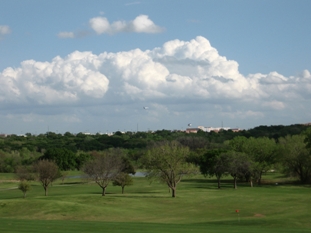 The view from the Grapevine Golf Course, looking south towards DFW.
Unlike New Hampshire, spring has clearly arrived here. I am struck most by the vibrant green of the leaves on the trees. And the cotton-ball clouds are always a welcome sight.
Sunday, March 25, 2007
Big D
The pilot just announced that we are starting our descent to DFW. For almost 20 years, this would have been a return flight, bringing me home. This trip, it’s away from home in
Living nearly two decades in
Saturday, December 30, 2006
First Snow
 We were starting to think that winter would never arrive. Never mind the passing of the winter solstice, winter is only official when it snows.
Ta da. Late morning a sleety mix began falling, and by noon there was undeniable evidence on the streets.
Winter has arrived.
Saturday, October 21, 2006
Expressions of Gratitude -- Part 1
Fourteen year ago today, at 12:13 am, Andrea began her journey in this world. Almost a young woman now, she's perky and caring and bright -- a wonderful gift of life. May she continue to flower and use her gifts to make this world a better place.
Grant, her younger brother, placed fourth in the Nashua city elementary school cross-country races this morning. He was the lead runner on the boys team from his school. Now in his third year of cross country, he's made great strides (pun intended) in improving his time. More importantly, running has allowed Grant to find his own path to achievement. May this experience strengthen his confidence and be a source of courage when he feels at a loss.
And may I be ever grateful for these two beings who so enrich my life. Soon they will be adults and living lives of their own.
Grant, her younger brother, placed fourth in the Nashua city elementary school cross-country races this morning. He was the lead runner on the boys team from his school. Now in his third year of cross country, he's made great strides (pun intended) in improving his time. More importantly, running has allowed Grant to find his own path to achievement. May this experience strengthen his confidence and be a source of courage when he feels at a loss.
And may I be ever grateful for these two beings who so enrich my life. Soon they will be adults and living lives of their own.
Tuesday, September 26, 2006
Boston to Chicago to San Jose
Mom,
I was up very early this morning to make a 7:00 am flight out of Logan, with the first stop Chicago, to change planes, and then on to San Jose. After two days of meetings here, I will hop over the Sierra to Reno on Thursday afternoon. This will be my first trip back since your memorial service. Lori is flying out Friday, and we'll spend an extended weekend organizing and sorting. No doubt that we won't get everything finished, but that will just give me another opportunity to return in a few weeks.
It was a perfect day for flying. Although there was some high cloudiness, the skies were quite clear, making for a smooth ride across the continent. The route to Chicago skirted Lakes Ontario and Erie and descended over Lake Michigan. I was sorry that I didn't catch a glimpse of Chicago's tall buildings, a city where we both spent some time. The high peaks of the Rockies already have fresh snow, while the Sierras still show just the remnants of last winter.
There are many memories for us in various cities stitched across this land: Chicago, Denver, Dallas, San Jose, Reno. We have full lives in these places -- but for such short times compared with history. Wasn't it Robert Frost who said life goes on? How should we measure the legacy of one life? Or is that entirely the wrong question?
Gary
P.S. Today was the first day of the TSA's relaxed restrictions for bringing liquids and gels on board aircraft. As instructed on the TSA web site, my deodorant, shaving cream, tooth paste, and contact lens solution were in two clear sandwich bags, which I placed in the bin with my laptop. After passing through the X-ray machine, there was a slight delay -- apparently because I hadn't filled out a form on the entry side of security ( I didn't see that part on the TSA web site). The agent was in a quandary and checked with his supervisor, who agreed to send me on with my various potions. It seems rather strange that a multi-billion-dollar transportation system and the technology of multi-million-dollar aircraft is so easily stymied by a tube of toothpaste.
I was up very early this morning to make a 7:00 am flight out of Logan, with the first stop Chicago, to change planes, and then on to San Jose. After two days of meetings here, I will hop over the Sierra to Reno on Thursday afternoon. This will be my first trip back since your memorial service. Lori is flying out Friday, and we'll spend an extended weekend organizing and sorting. No doubt that we won't get everything finished, but that will just give me another opportunity to return in a few weeks.
It was a perfect day for flying. Although there was some high cloudiness, the skies were quite clear, making for a smooth ride across the continent. The route to Chicago skirted Lakes Ontario and Erie and descended over Lake Michigan. I was sorry that I didn't catch a glimpse of Chicago's tall buildings, a city where we both spent some time. The high peaks of the Rockies already have fresh snow, while the Sierras still show just the remnants of last winter.
There are many memories for us in various cities stitched across this land: Chicago, Denver, Dallas, San Jose, Reno. We have full lives in these places -- but for such short times compared with history. Wasn't it Robert Frost who said life goes on? How should we measure the legacy of one life? Or is that entirely the wrong question?
Gary
P.S. Today was the first day of the TSA's relaxed restrictions for bringing liquids and gels on board aircraft. As instructed on the TSA web site, my deodorant, shaving cream, tooth paste, and contact lens solution were in two clear sandwich bags, which I placed in the bin with my laptop. After passing through the X-ray machine, there was a slight delay -- apparently because I hadn't filled out a form on the entry side of security ( I didn't see that part on the TSA web site). The agent was in a quandary and checked with his supervisor, who agreed to send me on with my various potions. It seems rather strange that a multi-billion-dollar transportation system and the technology of multi-million-dollar aircraft is so easily stymied by a tube of toothpaste.
Sunday, September 03, 2006
Last breath
It was just a week ago, Sunday, August 27th.
Mother had slept peacefully throughout the night, not awakening nor even moving since the prior afternoon. The last response I saw from her was when Patty, one of the hospice nurses, stopped by Saturday afternoon to examine her -- actually to assess how I was doing -- and had asked Mom several questions. She wasn't really alert but acknowledged Patty.
I spent the night on the floor in the bedroom with Mom, dozing then awakening every hour or so to check that she was still breathing. It was regular and peaceful. Her eyes were half open, which is how she had been sleeping for the past couple of weeks.
When Stephanie, the caregiver, arrived Sunday morning, I went out for my walk downtown along the river, which had become my morning respite while in Reno. I had a list of items to pick up at the store and thought about doing so after my walk, but decided to first check in at home.
Tomi walked across the street to see Mother around 10:30, earlier than her normal Sunday afternoon visits. Tomi was aware that my mom's condition had deteriorated and had e-mailed me that she would be over during the morning.
As we were chatting, Tomi commenting about the change in my mom in just a week, I noticed the rhythm of Mom's breathing change. The duration was shorter, her teeth were closing during part of the cycle, and I could hear some slight congestion. I gave Mom a dose of lorazepam, noticing that the set of her jaw made it difficult to insert the syringe. I noted the dosage and time on the log: 10:55 am. Within a couple of minutes, her breathing seemed to relax.
"Gary, I think your mom has stopped breathing."
Hearing Tomi's words, I immediately looked at Mom and moved to her side. I thought I saw a short breath, then a stillness, then another short breath. Her eyes had opened more fully, as though she might be awakening. But the breathing had stopped.
That same morning, Mom's church held their 14th anniversary celebration. Each summer her church marked the passage of another year by holding a Sunday service at Idewild Park. Several had hoped that Mom might be able to attend this year, since she was such an integral member of the church community. But as the week progressed, Mom became much too weak to go anywhere. By Friday she couldn't get out of bed to get to the bathroom; Debbie, one of the hospice nurses, installed a catheter.
As the church's anniversary service ended, 32 balloons were released in memory of each member who had died since the church was formed. There was no balloon for Mom, but her spirit must have joined them as they made their skyward ascent.
Mother had slept peacefully throughout the night, not awakening nor even moving since the prior afternoon. The last response I saw from her was when Patty, one of the hospice nurses, stopped by Saturday afternoon to examine her -- actually to assess how I was doing -- and had asked Mom several questions. She wasn't really alert but acknowledged Patty.
I spent the night on the floor in the bedroom with Mom, dozing then awakening every hour or so to check that she was still breathing. It was regular and peaceful. Her eyes were half open, which is how she had been sleeping for the past couple of weeks.
When Stephanie, the caregiver, arrived Sunday morning, I went out for my walk downtown along the river, which had become my morning respite while in Reno. I had a list of items to pick up at the store and thought about doing so after my walk, but decided to first check in at home.
Tomi walked across the street to see Mother around 10:30, earlier than her normal Sunday afternoon visits. Tomi was aware that my mom's condition had deteriorated and had e-mailed me that she would be over during the morning.
As we were chatting, Tomi commenting about the change in my mom in just a week, I noticed the rhythm of Mom's breathing change. The duration was shorter, her teeth were closing during part of the cycle, and I could hear some slight congestion. I gave Mom a dose of lorazepam, noticing that the set of her jaw made it difficult to insert the syringe. I noted the dosage and time on the log: 10:55 am. Within a couple of minutes, her breathing seemed to relax.
"Gary, I think your mom has stopped breathing."
Hearing Tomi's words, I immediately looked at Mom and moved to her side. I thought I saw a short breath, then a stillness, then another short breath. Her eyes had opened more fully, as though she might be awakening. But the breathing had stopped.
That same morning, Mom's church held their 14th anniversary celebration. Each summer her church marked the passage of another year by holding a Sunday service at Idewild Park. Several had hoped that Mom might be able to attend this year, since she was such an integral member of the church community. But as the week progressed, Mom became much too weak to go anywhere. By Friday she couldn't get out of bed to get to the bathroom; Debbie, one of the hospice nurses, installed a catheter.
As the church's anniversary service ended, 32 balloons were released in memory of each member who had died since the church was formed. There was no balloon for Mom, but her spirit must have joined them as they made their skyward ascent.
Friday, September 01, 2006
A beautiful day to die
August 27
Mom,
Shelly and I walked around Virginia Lake just after the sun had dropped behind the low-point of the Sierra, between Mount Rose and Peavine. A crescent moon was setting, and there wasn't a cloud in the sky. The heat of the day was waning with a slight breeze off the lake.
Debbie, the hospice nurse who examined you this afternoon, had commented that it was a beautiful day to die. It truly was.
Gary
Mom,
Shelly and I walked around Virginia Lake just after the sun had dropped behind the low-point of the Sierra, between Mount Rose and Peavine. A crescent moon was setting, and there wasn't a cloud in the sky. The heat of the day was waning with a slight breeze off the lake.
Debbie, the hospice nurse who examined you this afternoon, had commented that it was a beautiful day to die. It truly was.
Gary
Sunday, January 01, 2006
New Year Snow

New Year's eve brought a fresh layer of snow to southern New Hampshire, at least a couple inches to recover the grass.
Saturday, November 26, 2005
First snowfall

Nashua's first snowfall this 2005 season came Thanksgiving eve. We awoke to a blanket of white and a steady stream of falling flakes, a fitting accompaniment to a day of thanksgiving.
Monday, July 26, 2004
Flights home
Monday, July 26, 9:25 pm EDT and 30 minutes out of Manchester
The western sky is almost dark – just a faint band of twilight above dark clouds and below a blackening sky, with one planet brightly shining in the midst of the blackness. We’re flying along the tops of wispy clouds, with an occasional slight chop.
It was a beautiful morning flying out of Reno. I was seated at the window with a view to the west as we flew south. I saw Mount Rose and Slide Mountain, Washoe Valley, Lake Tahoe behind the front row of mountains, and Carson City with the blackened hills from the Waterfall fire. South of Genoa the plane turned westward over the Sierra and, somewhere below us, Yosemite.
The stop in San Jose was short. Most of the passengers left the plane, like my two seat-mates. The flight attendants counted those of us continuing on to LA and then boarded the new passengers. The flight from San Jose to LA, down the central valley of California, was uneventful. Off the plane in LA, I had a two hour layover, plenty of time for a Starbucks coffee, an energy bar for breakfast, and delving into the 9/11 Commission report. It was difficult finding a seat in the terminal, mobbed as it was by people, most seeming to fly Southwest. (There's a stock tip.)
My US Airways flight from LA to Charlotte was full except for one seat. They initially allowed one too many people on the plane and had to reopen the door to let off a man and woman, who must have been traveling together. I was lucky and upgraded to first class, so I had a comfortable seat for the four-hour flight, along with lunch. It consisted of a chicken and bacon salad (the former I ate, not the latter) and a chocolate chip cookie for dessert (which I resisted). But I did indulge in a glass of Chardonnay.
My layover in Charlotte lasted about an hour, sufficient time for a non-fat TCBY yogurt (my delayed dessert) and a bit more reading. On the flight to Manchester, I finished the power bar I had started in LA, with a hot tea. Now we’ve started our descent and are just about 10 minutes from the airport. We’ll arrive around 10:00, about 20 minutes early, and I’ll be home before 11:00.
Four flights in one day is too many. I’ve traced three sides of a rectangle around this country: Reno to LA, LA to Charlotte, and Charlotte to Manchester.
The western sky is almost dark – just a faint band of twilight above dark clouds and below a blackening sky, with one planet brightly shining in the midst of the blackness. We’re flying along the tops of wispy clouds, with an occasional slight chop.
It was a beautiful morning flying out of Reno. I was seated at the window with a view to the west as we flew south. I saw Mount Rose and Slide Mountain, Washoe Valley, Lake Tahoe behind the front row of mountains, and Carson City with the blackened hills from the Waterfall fire. South of Genoa the plane turned westward over the Sierra and, somewhere below us, Yosemite.
The stop in San Jose was short. Most of the passengers left the plane, like my two seat-mates. The flight attendants counted those of us continuing on to LA and then boarded the new passengers. The flight from San Jose to LA, down the central valley of California, was uneventful. Off the plane in LA, I had a two hour layover, plenty of time for a Starbucks coffee, an energy bar for breakfast, and delving into the 9/11 Commission report. It was difficult finding a seat in the terminal, mobbed as it was by people, most seeming to fly Southwest. (There's a stock tip.)
My US Airways flight from LA to Charlotte was full except for one seat. They initially allowed one too many people on the plane and had to reopen the door to let off a man and woman, who must have been traveling together. I was lucky and upgraded to first class, so I had a comfortable seat for the four-hour flight, along with lunch. It consisted of a chicken and bacon salad (the former I ate, not the latter) and a chocolate chip cookie for dessert (which I resisted). But I did indulge in a glass of Chardonnay.
My layover in Charlotte lasted about an hour, sufficient time for a non-fat TCBY yogurt (my delayed dessert) and a bit more reading. On the flight to Manchester, I finished the power bar I had started in LA, with a hot tea. Now we’ve started our descent and are just about 10 minutes from the airport. We’ll arrive around 10:00, about 20 minutes early, and I’ll be home before 11:00.
Four flights in one day is too many. I’ve traced three sides of a rectangle around this country: Reno to LA, LA to Charlotte, and Charlotte to Manchester.
Monday, May 31, 2004
Uplifting signs
It seems that spring has had a hard time sustaining itself this year. We have warm days, then cold days. The weather hasn't been at all consistent. But there are a few encouraging signs: the rhododendrons are in full bloom.

Friday, May 28, 2004
One pea at a time
There's nothing quite like being cramped in a seat on an airplane for nearly seven hours. 31D. On a Boeing 777, that's one seat in from the aisle on the middle row of five. Not much space within which to squirm. No way to get up or out to stretch or go to the bathroom without disturbing the man next to me.
For someone used to the frequent flyer perks of preferred seating -- exit row aisles, if not first class -- it comes to feel as an entitlement. When having to compromise comfort when the airline cannot accommodate, it's easy to become irritated.
Rather than let my feelings go that way, though, I'm trying to maintain humility, retain a positive attitude, and treat this as an opportunity for spiritual development. After all, someone has to sit in the middle. This is a chance to live in the present, to let time pass without willing it to accelerate, to eat one pea at a time from my meal; a time to practice mindfulness, according to Thich Nhat Hanh, the Buddhist author.
It's easier said than done, as I watch the miles and time seem to crawl by.
1425 miles out of Boston, after reading an article about the D-Day invasion 60 years ago, I'm mindful of the Jews who were crammed into rail cars to travel for days without food or water, being sent to their deaths in the concentration camps. A seven hour plane flight leading to a reunion with my family makes me a pretty fortunate guy, in comparison.
As I ponder the various dimensions of this spiritual quest, I just can't understand how the guy next to me -- the one on the aisle -- can drink two Cokes and a cup of coffee and not have to go to the bathroom!
For someone used to the frequent flyer perks of preferred seating -- exit row aisles, if not first class -- it comes to feel as an entitlement. When having to compromise comfort when the airline cannot accommodate, it's easy to become irritated.
Rather than let my feelings go that way, though, I'm trying to maintain humility, retain a positive attitude, and treat this as an opportunity for spiritual development. After all, someone has to sit in the middle. This is a chance to live in the present, to let time pass without willing it to accelerate, to eat one pea at a time from my meal; a time to practice mindfulness, according to Thich Nhat Hanh, the Buddhist author.
It's easier said than done, as I watch the miles and time seem to crawl by.
1425 miles out of Boston, after reading an article about the D-Day invasion 60 years ago, I'm mindful of the Jews who were crammed into rail cars to travel for days without food or water, being sent to their deaths in the concentration camps. A seven hour plane flight leading to a reunion with my family makes me a pretty fortunate guy, in comparison.
As I ponder the various dimensions of this spiritual quest, I just can't understand how the guy next to me -- the one on the aisle -- can drink two Cokes and a cup of coffee and not have to go to the bathroom!
London morning
London -- You never know where life will lead you and what paths you will only travel once. As John McCain was quoted in a recent profile in the Washington Post, "This is all so transient. It could all end tomorrow. My philosophy is just to just go, go like hell. Like Teddy Roosevelt did it. Full bore.”
With something of that same spirit, although I suspect not the same intensity, I decided to get up and go running on this, my last morning in London, before flying back to the U.S. From my hotel, I set out for Hyde Park, adjacent to Green Park. The sun was barely up as I ran along one length of the park, facing Knightsbridge I believe. The London traffic was fairly sparse, yet starting to build to its morning intensity. I ran by the rose garden, with roses and other flowers in full bloom. It would have been nice to stop and savor the colors and smells, but I had a 7:30 cab to Heathrow to catch. I kept running. The park was pretty empty but for a few other souls out running and a couple of homeless, one whom I awakened as I ran by him.
I think the last time I ran in Hyde Park was sometime between 1992 and 1994, or perhaps it was even earlier, between 1987 and 1989. Who knows when I will be back, if ever. I'm sure glad I got up and ran.
With something of that same spirit, although I suspect not the same intensity, I decided to get up and go running on this, my last morning in London, before flying back to the U.S. From my hotel, I set out for Hyde Park, adjacent to Green Park. The sun was barely up as I ran along one length of the park, facing Knightsbridge I believe. The London traffic was fairly sparse, yet starting to build to its morning intensity. I ran by the rose garden, with roses and other flowers in full bloom. It would have been nice to stop and savor the colors and smells, but I had a 7:30 cab to Heathrow to catch. I kept running. The park was pretty empty but for a few other souls out running and a couple of homeless, one whom I awakened as I ran by him.
I think the last time I ran in Hyde Park was sometime between 1992 and 1994, or perhaps it was even earlier, between 1987 and 1989. Who knows when I will be back, if ever. I'm sure glad I got up and ran.
Thursday, May 27, 2004
A break in the routine
London -- After our customer meeting today, we arrived back at the hotel with a good portion of the afternoon to ourselves. In my experience, free time is not normal on a business trip, so I decided to take advantage of this gift after quickly checking my e-mail and voicemail. Since I didn't run this morning -- opting for a 16 Pound Sterling continental breakfast instead -- I went out to jog through Green Park, which is across from the Park Lane hotel where we are staying.
Although my running was a bit lethargic, the day was glorious. The sun had emerged from the morning's gray clouds, warming the body in contrast to the cool breezes. London surrounded me, and the park was alive with people also savoring the afternoon.
The UK's Classic FM station was playing through my headphones, and I heard a debut of Hedwig's Song, the first track from the new John Williams soundtrack to the latest Harry Potter movie, Prisoner of Azkaban. The CD won't be in the stores until next week. Listening, while running, heightened my sense of being in a special place in the world.
Let me always be grateful for these simple gifts of life.
Although my running was a bit lethargic, the day was glorious. The sun had emerged from the morning's gray clouds, warming the body in contrast to the cool breezes. London surrounded me, and the park was alive with people also savoring the afternoon.
The UK's Classic FM station was playing through my headphones, and I heard a debut of Hedwig's Song, the first track from the new John Williams soundtrack to the latest Harry Potter movie, Prisoner of Azkaban. The CD won't be in the stores until next week. Listening, while running, heightened my sense of being in a special place in the world.
Let me always be grateful for these simple gifts of life.
It's a small world
London -- Yesterday at around 9:00 am, my flight pulled away from the gate at Logan airport. Five hours and 40 minutes later, after two meals, we landed at Heathrow in London. Tomorrow I fly back to Boston. The return flight will take slightly longer, perhaps an hour, due to westerly head winds.
A three day trip to attend a business meeting with a potential customer in London. Such is the nature of the global world we live in. This so-called jet-setting has become routine.
But consider that it's only been 100 years since the first airplane demonstrated that powered flight is possible. 100 years before that, the journey from Boston to London or London to Boston relied solely on the trade winds, took months, and was no routine voyage.
Today we take for granted advances that took the human endeavor thousands of years to accomplish. As we go about our business, which quickly becomes routine, we shouldn't lose sight of the wonder of this modern age in which we live.
A three day trip to attend a business meeting with a potential customer in London. Such is the nature of the global world we live in. This so-called jet-setting has become routine.
But consider that it's only been 100 years since the first airplane demonstrated that powered flight is possible. 100 years before that, the journey from Boston to London or London to Boston relied solely on the trade winds, took months, and was no routine voyage.
Today we take for granted advances that took the human endeavor thousands of years to accomplish. As we go about our business, which quickly becomes routine, we shouldn't lose sight of the wonder of this modern age in which we live.